

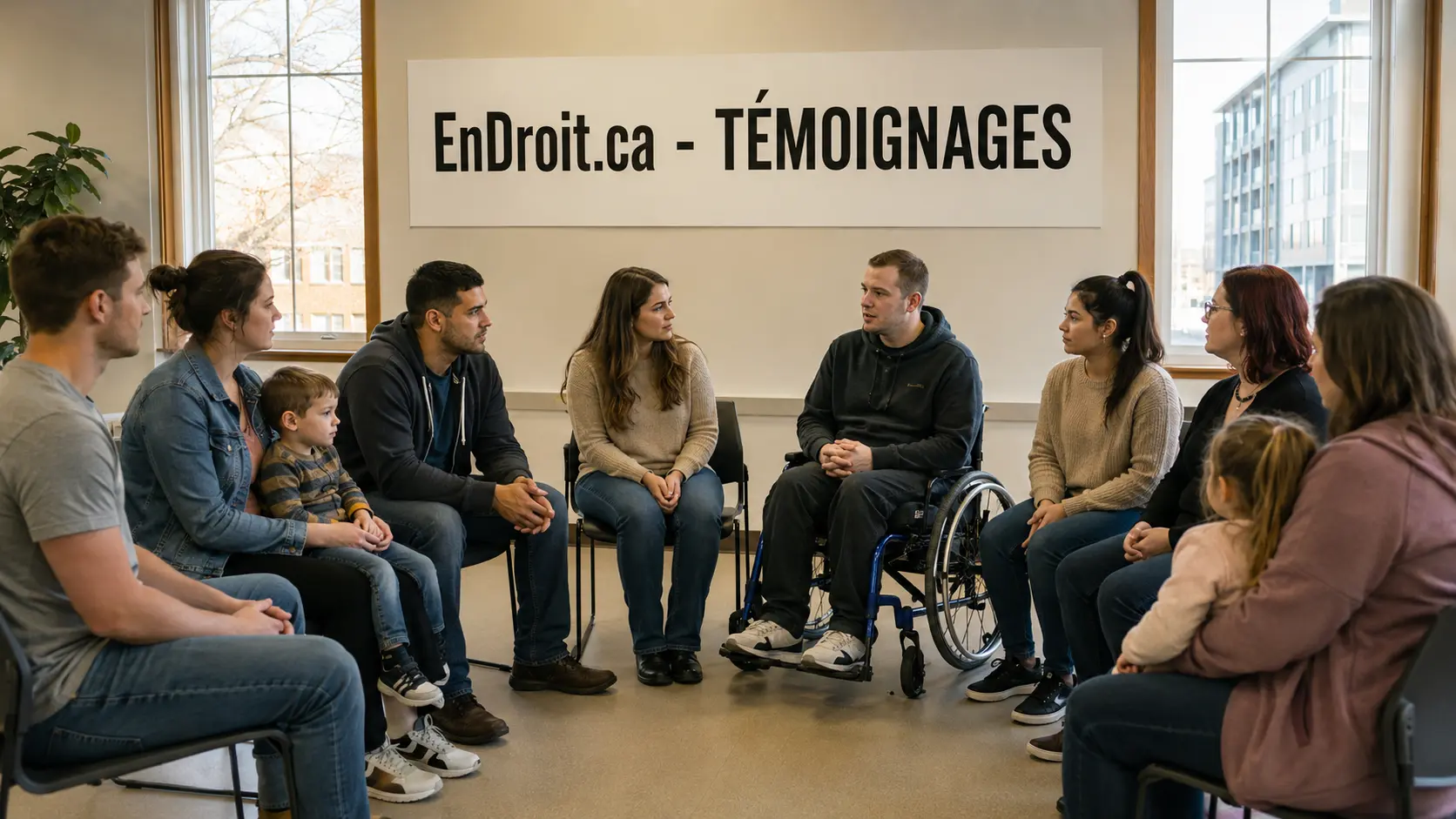


Yesterday, I had the honour of covering the Red Coalition’s press conference, held in response to the case of the 16 SPVM officers at Station 39. I felt chills as I listened to the testimonies of the victorious. This first article is only a beginning — EnDroit.ca will document this day as an archive in the weeks ahead.
I — Why this article
Chills, and the decision to document
What was said yesterday at the Red Coalition’s press conference cannot be summarized in a single article. That is why this one opens a series. Our platform will follow the developments over the coming weeks, because these testimonies — and the demands that accompany them — deserve to be preserved, passed on, and never forgotten.
Mr. Alain Babineau, Director of Racial Profiling and Public Safety at the Red Coalition, took the floor to explain what has been done — and what must be done now. His demand is clear: a public inquiry.
The part of the file our platform will follow most closely is directly tied to our editorial mission: Mr. Babineau announced that he has filed a formal request with the Quebec Ombudsman (Protecteur du citoyen). That is precisely the institutional angle our team has been investigating for months — the real accountability of the institutions tasked with protecting citizens in Quebec.

Our ongoing investigation covers the full chain of accountability mechanisms in Quebec: the CDPDJ, the DPCP, police services (from Repentigny to Montreal, passing through Longueuil and several others documented), the Quebec Ombudsman, the Quebec Bar (Barreau du Québec), and the Office des professions. A full investigation into the discrimination documented at the Repentigny police station will also be published on our platform in the coming weeks. It is in that continuity that we will follow the file referred by the Red Coalition.
II — The context
What happened at SPVM Station 39
For those discovering the context: on June 12, 2026, the Director of the Service de police de la Ville de Montréal, Fady Dagher, held an extraordinary press conference to announce the complete dismantling of a patrol team from Neighbourhood Station 39, in Montréal-Nord.
In total, 16 officers are under investigation. Two have been suspended and their file is being reviewed by the Director of Criminal and Penal Prosecutions (DPCP) with a view to possible criminal charges. Fourteen others have been reassigned to duties without contact with the public. According to reports from La Presse and Radio-Canada, some officers allegedly cut the hair of racialized citizens to keep as « trophies. » The investigation, launched in March 2026, originated from internal whistleblowing — it was other officers from the same station, outraged, who came forward.
III — The demands
That reports stop being empty, that judgments stop being empty
Alain Babineau and the Red Coalition are calling for transparency, clear investigations, and real accountability. They demand that reports stop being empty, that judgments stop being empty. That the institutions tasked with protecting the public stop producing decisions that say nothing — that close files without reasons, dismiss complaints without hearings, and refer fundamental rights questions to committees that lack the jurisdiction to resolve them.
We had already documented this mechanism in our investigation « The Judges Without Judgment » — and that is precisely what Mr. Babineau put back on the table yesterday.
IV — The origin of the Red Coalition
Joël DeBellefeuille — the story that became case law
The founder of the Red Coalition, Joël DeBellefeuille, shared his story and explained why he created this movement. And his story, as you all know, became case law in Quebec.
Joël DeBellefeuille, founder of the Red Coalition, tells the story himself — the July 2009 Longueuil police stop that became Quebec case law. Press conference, June 2026.
In July 2009, Mr. DeBellefeuille was pulled over by Longueuil police officers while driving with his family. Later, when he received the police report, he discovered what the officers had written in black and white: « the vehicle belonged to a certain Debellefeuille Joël, it was a Black man [sic] who did not match, at first sight, the owner. Debellefeuille sounds like a Quebecois family name, not one of another origin. »
On September 20, 2012, after three years of legal battle, Judge Pierre-Armand Tremblay of the Longueuil Municipal Court rendered a landmark 66-page decision. He ruled that Mr. DeBellefeuille had indeed been a victim of racial profiling, and that his constitutional rights to equality and protection against arbitrary detention had been violated. All the evidence obtained was excluded. The judge wrote: « To believe falsely or out of ignorance that the family name Debellefeuille could not be the surname of a Black person can only reflect a flagrant lack of knowledge of Quebec society ».
In November 2020, in a second file involving a 2012 stop, the Human Rights Tribunal of Quebec ordered two officers and the City of Longueuil to pay Mr. DeBellefeuille $12,000 — $10,000 in moral damages, $2,000 in punitive damages. The Tribunal also ordered the City to collect and publish annual statistics on the perceived ethnic origin of people stopped by its police, and to provide training to its entire police force.
This case law — the 2012 ruling and the 2020 one — has become a judicial reference used in more than 240 cases in Quebec since. It is the story of one man, stopped because he was Black behind the wheel of a vehicle deemed « not for him. » That is racial profiling. Those are the unacceptable stories.
V — The faces of the victorious
They are not victims — they are the victorious
We then had the chance to listen to witnesses. Men and women stopped on grounds that defy understanding. And as Alain Babineau so rightly said yesterday — and this is the phrasing that stays with me most — you cannot call them « victims ». You cannot categorize them that way.
They are the victorious. They survived. They spoke out. They filed complaints. They won — or they are still fighting.


The faces of the victorious and the members of the Red Coalition’s Board of Directors. Press conference, Montreal, June 2026.
And it is this part — the testimonies themselves — that we will be presenting in upcoming articles. Not in this one. Because each of these accounts deserves its own space, treated with rigour, with respect, and with the legal caution required when reporting on facts whose proceedings are ongoing.
VI — Eleven days earlier
Before Dagher’s press conference — Alain Babineau’s column on EnDroit.ca
I want to share a factual observation here, without triumphalism. On June 1, 2026, our platform published « Police Disengagement: Internal Reality, Political Recycling », a column signed by Mr. Alain Babineau, JD/BCL, a McGill-trained jurist and former RCMP staff sergeant.
In that text, written eleven days before the SPVM’s June 12 press conference, Mr. Babineau identified, with precision, the mechanism by which dysfunctional police cultures are transmitted — not through external oversight, but inside the police forces themselves, by field training officers who « unteach » the academy, by negative veterans who normalize avoidance, by a subculture that survives every external reform. He also identified the typical scenario: when revelation occurs, it comes from the inside — through colleagues of integrity who eventually speak up.
That is exactly what happened at Station 39, where it was officers themselves who reported their colleagues. And that is exactly the mechanism Mr. Babineau anticipated, both in his column and yesterday, before the journalists.
I am not bringing this article back to congratulate myself. I bring it back to explain why EnDroit.ca publishes Alain Babineau as a collaborator: because his reading of the field is rigorous, measured, documented, and accurate — often before the institutions acknowledge what he has already described.
VII — The three fundamental questions
What a genuine systemic inquiry must ask
In addition, our collaborator Alain Babineau provided us with the supplementary information below. He lays out, with the precision of a jurist and the measured tone of a former senior officer, the questions any systemic inquiry worthy of the name must ask — and identifies the people who should be interviewed.
There have been many questions raised regarding Chief Fady Dagher‘s role in the SPVM Poste 39 racism scandal. While accountability for any policing organization ultimately rests with its chief, it would be unfair to attribute sole responsibility to him for the conduct of individual officers within the organization he leads.
Leadership carries with it a duty to establish clear expectations, foster an ethical culture, and respond appropriately when misconduct is identified. However, responsibility for racist behavior must first and foremost rest with those who engage in it through acts of commission but also through acts of omission.
Unless it can be demonstrated that Chief Dagher was aware of the misconduct and failed to take timely and appropriate action, it would be inappropriate to hold him personally accountable for every instance of wrongdoing committed by members of the organization. The key question is not simply whether misconduct occurred, but whether the leadership responded effectively once it became aware of the problem.
Three fundamental questions must be asked during such a systemic investigation:
1. Were you aware of racist behaviour occurring at Poste 39?
2. When did you find out about it?
3. What did you do about it?
This month, Maxime St-Pierre assumed the role of Commandant of PDQ 39. His predecessor, Hélène Mercier, served as Commandant for approximately three years, from 2023 until June 2026, and coincidentally announced her retirement this month. However, Cédric Couture (Direction des services de proximité), responsible for neighborhood police stations (PDQs) and community policing initiatives, and Marc Charbonneau (Direction des services organisationnels), managing internal logistics, corporate services, and operations, should also be interviewed.
To obtain a comprehensive understanding of the organizational culture and systemic issues that may have existed at PDQ 39 over time, it would be prudent to interview several former commandants who oversaw the station during significant periods in its history. For example:
· Miguël Alston, MAP, served as Commandant of PDQ 39 around 2018 and was responsible for managing relations with the community during the tenth anniversary of the highly publicized shooting of Fredy Villanueva.
· Jonathan Martel commanded the station during a particularly sensitive period around 2016 during police intervention involving Bony Jean-Pierre.
· Roger Jr. Bélair served as Commandant during the 2008 fatal shooting of Fredy Villanueva. He later provided extensive testimony regarding the station’s operational response to the incident, as well as the supervisory oversight exercised in its immediate aftermath.
These questions and these names do not constitute an accusation. They constitute the methodological structure of a serious inquiry — the one the Red Coalition has been calling for from the start, and the one we will follow at EnDroit.ca with the rigour it deserves.
VIII — What is coming next
What we will be following in the weeks ahead
EnDroit.ca will document this press conference as an archive. Here, without fixed order, is what we will cover in upcoming articles:
· The testimonies of the victorious — police stops on baffling grounds, presented with the respect and legal caution required.
· Follow-up on the Red Coalition’s request to the Quebec Ombudsman — directly tied to our ongoing investigation into the accountability of Quebec’s oversight institutions.
· Follow-up before the CDPDJ and other mechanisms announced yesterday.
· Analysis of the DeBellefeuille case law — 2012, 2020, and how Quebec courts have used it since.
· The intersection between the Station 39 affair, Babineau’s June 1 column, and the demands made yesterday — how these three pieces, taken together, point to a structural question that cannot be reduced to « a few bad apples. »
IX — A personal note
A partner to their story
It was with great respect, deep humility — and above all, profound incomprehension that I attended this historic press conference yesterday. It must not be forgotten. That is why our platform will document it as an archive — so that these testimonies, and the demands that accompany them, are never erased.
This article is not my story. It is theirs. Mine is to document it. EnDroit.ca is honoured to be a partner in their work — not a megaphone, not a substitute, but an independent editorial partner committed to transmitting what was said, with rigour and with respect.

While we wait for the next installments, here is the most important thing I took away from this day:
Today, you must be antiracist.
· Insulting a Police Officer — What the Law Really Says · by Alain Babineau
· The Crime We Choose to See — and to Ignore · by Alain Babineau
· The Judges Without Judgment — When Decisions Say Nothing
· Alain Babineau — Trust and References Page
· Investigations — EnDroit.ca Newsroom
Editorial note. This article is a signed editorial coverage of a public press conference held by the Red Coalition. EnDroit.ca is an independent citizen platform of legal journalism, not affiliated with the Red Coalition, the Service de police de la Ville de Montréal, the City of Longueuil, the CDPDJ, the DPCP, the Quebec Ombudsman, the Quebec Bar or any other official organization. The presumption of innocence and the presumption of good faith are strictly respected with respect to Chief Fady Dagher, all the commanders named in this article, the former commanders, and all officers under investigation, including those at SPVM Station 39. The names of some current and former SPVM managers are mentioned for documentary purposes only, in the context of an editorial contribution identifying persons whose hearing would be relevant in a possible systemic inquiry. Nothing published here constitutes an accusation of criminal or disciplinary fault against any individual: only the competent authorities can render such conclusions. This article does not constitute legal advice. The author is not a lawyer.
AI disclosure. This publication was prepared with the assistance of generative AI tools, which may invent facts, figures, or legal provisions: always verify with an official source, a lawyer, or on Légis Québec.
Sources and references
Red Coalition press conference — covered in person by EnDroit.ca, June 2026.
SPVM Station 39. Press conference by Chief Fady Dagher, June 12, 2026. Coverage: La Presse, Radio-Canada, Le Devoir, Noovo Info, L’actualité. Official SPVM communiqué (Station 39).
Editorial contribution by Alain Babineau (Section VII). Original English text provided by the author, reproduced here verbatim. A French translation is available in the French version of this article.
DeBellefeuille case law. Longueuil Municipal Court, Judge Pierre-Armand Tremblay, September 20, 2012 (66 pages). Human Rights Tribunal of Quebec, November 17, 2020, condemning the City of Longueuil and two officers to pay $12,000 for racial profiling. Historical coverage: Radio-Canada, CBC News, Le Courrier du Sud, CRARR (Center for Research-Action on Race Relations).
Earlier column published on EnDroit.ca. Alain Babineau, JD/BCL, « Police Disengagement: Internal Reality, Political Recycling », June 1, 2026.
This article is a signed editorial coverage based on a public press conference and public sources. EnDroit.ca is an independent platform of legal journalism. This article does not constitute legal advice. The author is not a lawyer.
Auteur/autrice

En savoir plus sur EnDroit.ca
Subscribe to get the latest posts sent to your email.