

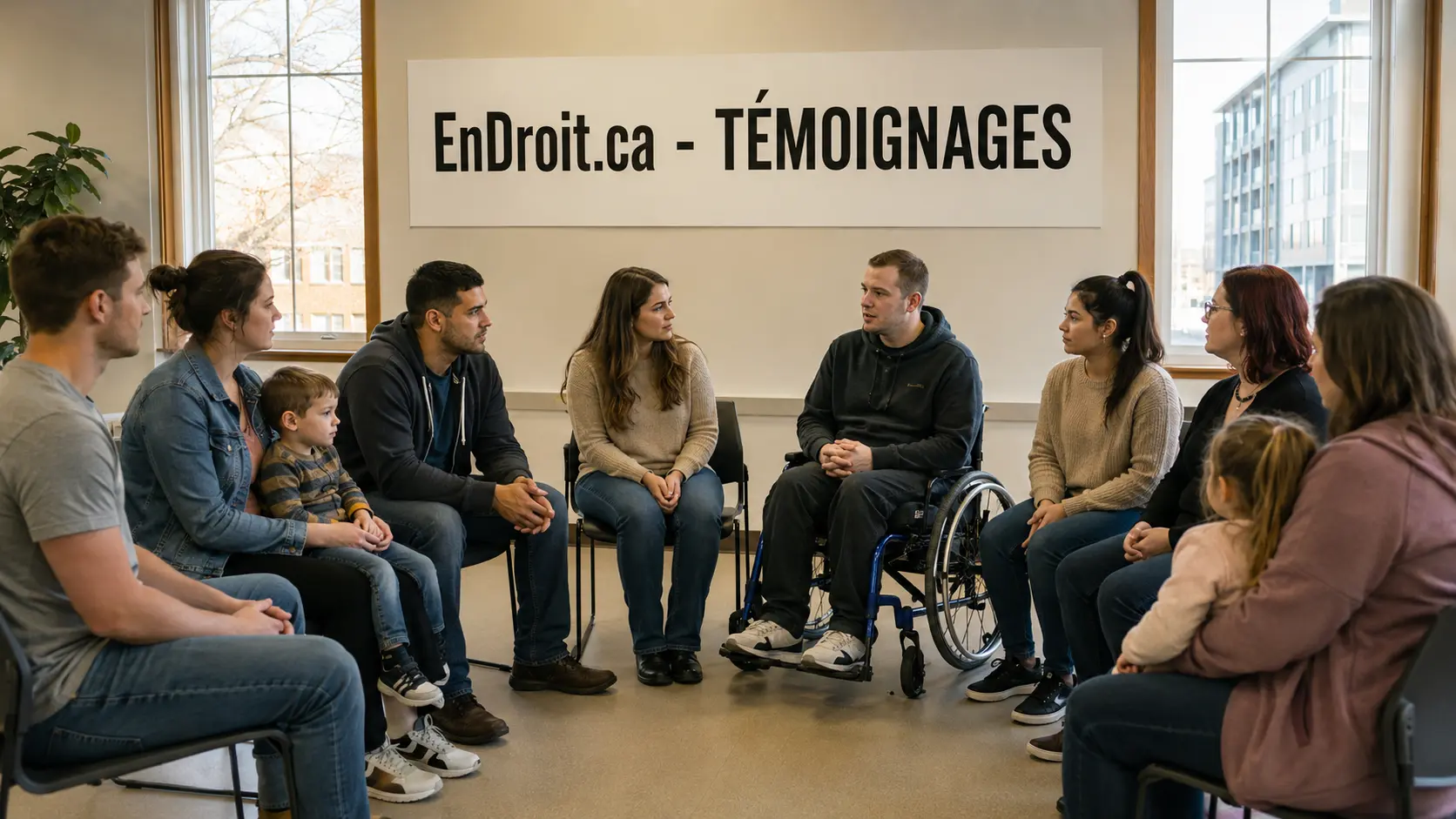
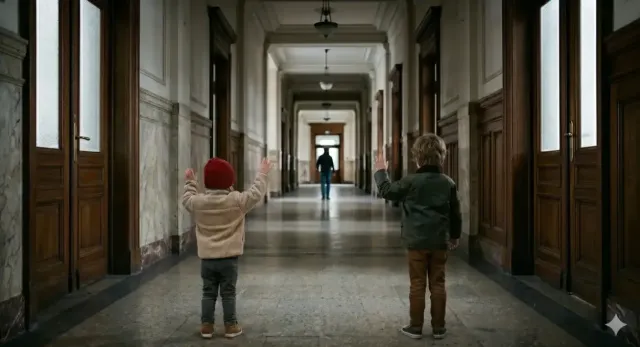

An autistic father living with Tourette syndrome describes a judicial and policing sequence that, in his account, cost him access to his children after a separation. He was acquitted on every count. The children did not come back.
« I was mowing my lawn. Two hours later I was being treated like a terrorist. »
That is how Julien sums up the police operation that, in his account, upended his life.
This father, who is autistic and lives with Tourette syndrome, says that in the course of a separation he lost access to his children following a chain of judicial and police events he now describes as discriminatory.
I — The morningAn armoured vehicle for two hunting rifles
According to his account and to access-to-information documents, the matter begins with two hunting rifles belonging to his former partner. He says he insisted they be removed before he left the family home. Despite confirmation that they were no longer there, he says he found them hidden under a staircase.

Fearing he would be wrongly implicated, he says he dismantled the weapons and handed the parts to his father so they could be returned to their owner.
A few days later, a neighbour called him: a major police operation was under way at his home.
An armoured vehicle. Officers in tactical gear. Dog handlers. A bomb squad.
Julien was arrested, handcuffed and questioned about weapons, explosives and a possible bunker — all of which he categorically denies.
No explosives and no arsenal were found in the search. The most serious charges — manufacturing explosives and illegal possession of weapons — were reportedly dropped before they were even formally laid. Death-threat charges, which he says rested on second-hand accounts he considers not credible, were subsequently withdrawn.
At the end of the process, he says he was acquitted on every count.
The file collapsed. The label stayed.
II — The courtroomWhen neurology is read as instability
Julien believes his autism shaped how he was perceived in court.
He says that during one hearing, Justice Pierre Labelle told him that « a person like him » did not deserve a lawyer — which, he says, forced him to represent himself from that point on, despite his disability.
A second judge, Stéphane Lacoste, denied him his reasonable accommodations and the support person he had requested for hearings, as recorded in the minutes of 18 November 2025.
He also reports that his former lawyer, Me Bianca Vigneault, said to him:
« A person like you doesn’t deserve to have children. »
These alleged statements have not been confirmed by the parties named. Julien presents them as examples of what he calls « subtle systemic discrimination », in which his manner of communicating and his intensity were read as signs of instability — despite a neurological assessment placing him in the 98th percentile for intellectual ability.
III — The hearing« Sign, or lose the children »
He maintains that the rupture with his children did not come from a single ruling, but from an accumulation of decisions taken under sustained pressure.
He says psychosocial reports and youth protection assessments favoured shared custody, but were kept from the court by his own lawyer, Me Michel Lachance. He states that Me Lachance remains the subject of a disciplinary investigation by the Bureau du syndic, and that Me David Chun resigned from the Barreau du Québec while an investigation was under way. Both of those points were independently confirmed for the original French article.
One episode in particular sustains his sense of injustice.
Then represented by Me Bianca Vigneault through legal aid, Julien says he initially believed he had found an ally: she told him his file was strong, and that an emergency safeguard hearing — announced on a Friday for the following Thursday — would be a formality, particularly since youth protection was, in his account, supporting his position with favourable reports.
As the date approached, he describes total silence: calls, emails and messages going unanswered.
The day before the hearing, worried about appearing alone, he contacted youth protection himself and says he obtained a message to convey to the court, inviting it to await the final report. Shortly after leaving his lawyer a message saying he would go to the courthouse regardless, she called back and assured him that the hearing had been cancelled. His former partner reportedly wrote him the same thing.
The next day, checking the court list, he found the hearing was proceeding.
Once there, he says he was kept away from the courtroom, isolated in a cubicle and pressed to sign a lengthy document — dozens of pages drafted by opposing counsel David Chun, who resigned from the Barreau du Québec on 5 February 2025 while under investigation by the Bureau du syndic. The document was intended in part for youth protection, and described him as dangerous.
Julien refused to sign. It was at that moment, he says, that his lawyer told him:
« Listen, a person like you doesn’t deserve to have children. Either you sign, or we’ve already arranged it so you never see your children again. »
He maintains these words were spoken despite psychosocial reports and assessments that favoured him. He eventually entered the courtroom just as opposing counsel was pleading his « absence ».
For him, that episode marked the point of no return.
« I understood that the fight was no longer about the facts. It was about the image. »
IV — The closed circleInstitutions that hand the file to one another
Julien says his appeal is ongoing, and that a police ethics investigation is under way.
He describes a system in which, in his view, the institutions pass responsibility back and forth: courts, the Barreau and disciplinary bodies operating « in a closed circuit ».
Since February 2026, EnDroit.ca has reported that Me Anne-France Goldwater is said to have passed information to the Barreau concerning what she described as serious criminal fraud in the file associated with former lawyer David Chun, previously of Spunt & Carin. Despite those alleged elements, the Bureau du syndic maintains the closure of the file.
V — The police stationA complaint they would not write down
Following these events, and what he describes as false statements about him and repeated harassment and parental alienation, Julien went several times to the Repentigny police station to file a formal complaint. Officers declined to register it.
He recorded audio in which, he says, he is told that he is only there to give them grief — and that his facial tics and apparent nervousness make him look like a drug user.
He was, at that moment, explaining that he lives with Tourette syndrome.
Beyond one caseWhat this file asks of the system
Through his platform, Julien says he wants to move beyond his own case and raise broader issues: the complexity of procedure, the cost of litigation, access to evidence, and the weight of reputation in family files.
« A single word can mobilize an army against you. »
At the centre of the debate sits a genuinely difficult question: the balance between protecting children, parental rights, and how a court perceives a parent who is neurodivergent.
For Julien, the stake is simpler than that. He wants a place in his children’s lives.
And he refuses to accept that a neurodivergent parent should be judged on his symptoms rather than on his love.
EnDroit.ca collects accounts from people who have lived through comparable situations. If you have a story to tell, write to us at endroit.ca@outlook.com. Your account will be read carefully, verified before publication, and anonymized on request.
The children did not come back.
EnDroit.ca · Information as leverage. Access to justice for all.
Editorial note. This is the English version of an article first published in French on 17 February 2026. It reports the account of one person — identified by the pseudonym Julien to protect the identity of his children — drawn from his own testimony, from access-to-information documents, and from judicial material reviewed by the EnDroit.ca team.
Nothing here has been adjudicated. The statements attributed to the judges, lawyers and police officers named are allegations. They have not been confirmed by the parties concerned and have not been ruled on by any court or disciplinary body. In keeping with the presumption of innocence and the presumption of good faith, the persons named remain presumed to have acted in accordance with their professional obligations unless and until a competent authority decides otherwise.
One account, not a finding. This article presents one person’s experience and perception of events. It is not a determination of fact by EnDroit.ca.
Right of reply. Any person or institution named in this article may send us a reply, which we undertake to publish in full, at the address above.
Translation. This article was translated from French. Statements originally made in French have been translated into English; where precise wording matters, the French original prevails.
EnDroit.ca is an independent citizen platform. The author is not a lawyer. This article does not constitute legal advice.
Sources
Testimony of the subject, gathered by EnDroit.ca · Access-to-information documents · Minutes of the hearing of 18 November 2025 · Barreau du Québec, notice of resignation dated 5 February 2025 · Neurological assessment provided by the subject · Audio recordings provided by the subject · Court documents reviewed by EnDroit.ca.
French version: « Une personne comme toi ne mérite pas d’avoir des enfants » — Un père autiste séparé de ses enfants.
Auteur/autrice

En savoir plus sur EnDroit.ca
Subscribe to get the latest posts sent to your email.