

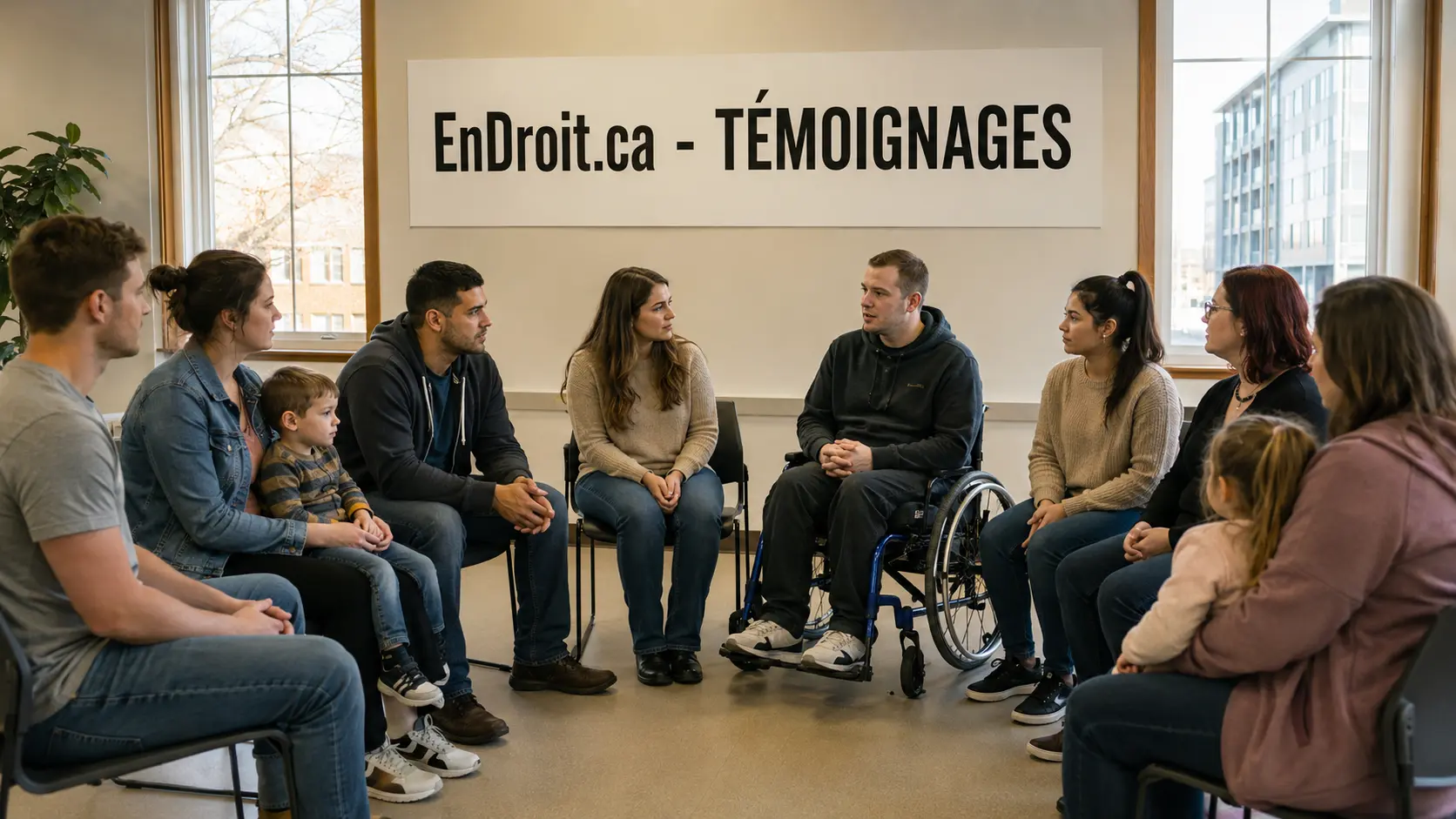


We put five questions on access to justice to those who are about to shape the law of tomorrow. The Association of Students in Access to Justice (AÉDAJ) of the University of Ottawa answered us — at length, seriously, and with a clarity that deserves to be read. Here are their answers, in full.
The answers published here are those sent by the Association of Students in Access to Justice (AÉDAJ) of the University of Ottawa, reproduced in full, without cuts. They were provided in French and translated by EnDroit.ca for our English-language readers. The French version is authoritative. The original document is available below, so that anyone can verify.
At EnDroit.ca, we sent the same set of questions on access to justice to voices that are, too often, not consulted on the subject. Among them, the next generation of jurists — those who are studying law today and who will practise it tomorrow. The Association of Students in Access to Justice (AÉDAJ) of the University of Ottawa, chaired by Maëlys Mensah, took the time to answer us with remarkable care.
These are not answers of convenience. One senses the field, the direct observation, and a fine understanding of the system’s blind spots. We publish them here in their entirety, because they deserve it.
Question 1The obstacles to access to justice
Based on what you observe, what are the main obstacles preventing citizens from truly accessing justice today?

From the point of view of our Association and its members, we believe that several obstacles continue to limit real access to justice for citizens. The costs associated with legal services remain a significant barrier, as they can prevent many people from exercising their rights.
We also observe that misinformation surrounding how the legal system works means that many citizens do not know what steps to take, nor which resources are available to them.
Added to this is the complexity of the legal system, whose procedures and language can be difficult to understand for someone unfamiliar with the law. Finally, waiting times, which can be particularly long, sometimes discourage victims from beginning the judicial process or from seeing it through to the end.
In our view, these various factors demonstrate the importance of continuing the efforts to make justice more accessible, more understandable and more efficient for all.
Question 2Citizens who represent themselves
A growing number of citizens appear alone before the courts. How do you perceive this reality, and what would it take to better support them?
From the point of view of our Association and its members, we perceive this reality as both inspiring and troubling. It is inspiring, since it is encouraging to see that some people choose to take their case into their own hands when legal services are not financially accessible. This reflects their determination to assert their rights despite the obstacles they face.
However, this reality is also disappointing, as it highlights a significant flaw in our justice system. People who already have the knowledge, the skills or the resources needed to represent themselves will often have a better chance of asserting their rights effectively. Conversely, those who have neither the means to retain a lawyer nor sufficient legal knowledge risk being disadvantaged. This situation contributes to widening the gap between citizens for whom justice is truly accessible and those for whom it remains difficult to reach.
That said, our exchanges with several lawyers, particularly those working in legal aid, have also shown us that many professionals are willing to offer their support when needed. Even when a person chooses to represent themselves, there is a genuine willingness, on the part of many lawyers and sometimes even the courts, to guide them so that they can better understand the judicial process.
In our view, several measures would help to better support citizens who represent themselves. First, it would be worthwhile to introduce, as early as high school, a basic education on citizens’ rights and how the legal system works. Better legal literacy would allow citizens to better understand their rights and the recourses available to them. Next, it would be desirable to develop more support programs, such as the pro bono justice initiatives offered in courthouses, so that people trained in law can provide information and advice to litigants who choose to represent themselves. Such initiatives would help make justice more accessible and reduce inequalities between citizens.
Question 3The next generation’s concern
As the next generation entering the profession, what concerns you most about the justice system as it currently operates?
What seems most concerning to us is the total lack of knowledge of the judicial system on the part of non-jurist citizens. There is an enormous gap between jurists and non-jurists. How many times, being only a student, am I asked the following question: how can I learn my rights without having to ask someone (such as a lawyer)? And I answer that the laws are available online. Then this question constantly follows: realistically, how can a citizen without legal training find the answer to their questions? In fact, the truth is that we, the jurists, take university courses in law to learn how to read the Civil Code, for example, yet we ask citizens to understand it by themselves. Because, I remind you, Nemo censetur ignorare legem; no one is deemed to be ignorant of the law. Here, there is a contradiction. So the citizens’ lack of knowledge of the resources available to learn their rights is very concerning, since it draws a line between citizens who have the financial means to obtain a lawyer’s services and those who do not.
But there is more. Citizens’ lack of knowledge also encompasses the roles of each of the actors in the justice system. The truth is that most of the population do not know what a clerk or a paralegal is. This aspect is concerning, since we ask citizens to trust a system they do not understand. This contributes to the lack of access to justice, because citizens do not even know whom to turn to when they cannot afford a lawyer.
Question 4Access to justice in the regions
Is access to justice in the regions, outside major centres, an issue that resonates with your association or your members?
Access to justice in the regions is an issue that resonates with the members of our association, who come, for the most part, from those very regions. Indeed, practice among jurists seems to be far less attractive in the regions than in major centres. This can therefore cause a shortage of workforce or of financial resources. Moreover, there are even regions for which access to justice is virtually non-existent. One can think of certain regions in the far north of Quebec, where the justice system is almost inaccessible. Travel can be complicated, as it is often done by plane or by boat, since there are places that cannot be reached otherwise. Linguistic issues can come into play. And there is also the Indigenous reality versus the colonial mindset that is an integral part of the Quebec justice system.
In short, several issues make access to justice virtually non-existent in certain regions and/or communities, since there are not as many resources mobilized to guide judicialized citizens in these places. So this can quickly turn into stories of David against Goliath. Nonetheless, it is important that all citizens understand how the system works, as well as their rights, and be able to defend those rights in a system that is far from intuitive, with all its procedural rules and its decorum.
Question 5One priority for decision-makers
If you could bring a single priority to the attention of decision-makers regarding access to justice, what would it be?
If we could bring a single priority to the attention of decision-makers regarding access to justice, it would be to better equip citizens so that they are able to understand their rights and to find their way through the legal system. We believe we must recognize that, over the coming years, a growing number of people will be led to represent themselves, notably because of the cost of legal services, but also because of the emergence of tools such as artificial intelligence, which make legal information more easily accessible.
In this context, improving access to justice should not only mean making lawyers’ services more accessible, as essential as that is. Citizens must also be given the knowledge needed to understand the foundations of their rights, to recognize when they have suffered harm, and to know the first steps to take. Better legal literacy, integrated in particular into the school curriculum, would allow every citizen to acquire basic notions about how the justice system works and the resources at their disposal.
According to our Association and its members, a better-informed population is a more autonomous population, more confident and better able to exercise its rights. Educating citizens about justice does not replace the role of legal professionals, but constitutes an essential lever to reduce inequalities in access to justice and to foster a system that is more accessible, more equitable and better suited to today’s realities.
EnDroit.ca · Law, closer to citizens
Our reading of these answers
One thing stands out on reading these five answers: the next generation does not place the cost of legal services at the top of its concerns. It mentions cost, of course — but treats it as the symptom of a deeper ailment, that of legal illiteracy. The gap between jurists and non-jurists, they say, is such that citizens are expected to understand on their own a system that law faculties take years to teach. Their invocation of the old maxim — « no one is deemed to be ignorant of the law » — turned back against the system itself is, in our view, one of the most accurate formulations we have read on the subject.
This analysis speaks directly to the very purpose of EnDroit.ca. From day one, we have defended the idea that information is a lever of equality: that an equipped citizen, one who understands their rights and knows where to turn, is a less vulnerable citizen. To see this conviction expressed by those who are studying law today is no coincidence of convergence — it is the sign that an entire generation is arriving with this clarity.
Their answer on the regions deserves attention. Where institutional discourse speaks in generalities, the AÉDAJ names concrete realities: the far north where justice can be reached only by plane or by boat, the linguistic issues, the encounter between the Indigenous reality and a system inherited from a colonial logic. These are not abstractions for these students — several of them come from those regions. Their image of « David against Goliath » sums up, better than lengthy reports, the imbalance experienced by the isolated citizen.
Finally, their priority — to better equip citizens, notably through legal literacy and through new tools such as artificial intelligence — matches precisely what we are trying to build. The idea of a basic education on rights starting in high school is a public-policy choice that will belong to decision-makers; but the intuition behind it strikes us as profoundly sound: a better-informed population is a freer population.
What this says about the next generation
It is often said that the justice system will change from the top — through laws, courts and professional orders. The quality of these answers suggests something else: that it will also change through those who enter it today with their eyes wide open to its flaws. Students who, even before being sworn in, are already thinking about the person left alone before a court they do not understand — that gives reason for hope.
We sincerely thank the AÉDAJ and its president, Maëlys Mensah, for agreeing to contribute to this initiative with such generosity. EnDroit.ca will have the pleasure of continuing the dialogue with this next generation: we will be at the University of Ottawa this autumn, at the Association’s invitation, to discuss access to justice in person. We look forward to it.
Full reproduction. The answers published above are reproduced in their entirety, as transmitted by the Association of Students in Access to Justice (AÉDAJ) of the University of Ottawa. The complete original document is available for download above.
Translation. The answers were provided in French. The English text published here is a faithful translation by EnDroit.ca, offered for the benefit of our English-language readers. In case of any discrepancy, the French version is authoritative and remains available in the original document above.
Attribution. These answers express the position of the student Association, and not that of the University of Ottawa or its Faculty of Law.
Transparency. The AÉDAJ has invited the founder of EnDroit.ca to give a lecture on access to justice at the University of Ottawa in the autumn of 2026. We mention this in the interest of transparency.
An assumed vision. On political and partisan questions, EnDroit.ca remains strictly neutral. On its mission — access to justice, citizens’ understanding of the law, and the role of information as a lever of equality — the platform has a vision, one that is known and assumed. The analysis presented here stems from it.
This text does not constitute legal advice.
References
Association of Students in Access to Justice (AÉDAJ) of the University of Ottawa, written answers sent to EnDroit.ca, July 2026 (document available for download above).
EnDroit.ca, Request for contribution — access to justice as seen by the next generation of jurists, July 2026.
Barreau du Québec, Quebec Summit on the Rule of Law, September 8 and 9, 2026.
French version of this article: La relève juridique a la parole : l’AÉDAJ répond aux citoyens.
Auteur/autrice

En savoir plus sur EnDroit.ca
Subscribe to get the latest posts sent to your email.