



SOQUIJ. Éducaloi. JuridiQC. The Centres Info Justice. The Fondation du Barreau. Justice Pro Bono. Juripop. Legal aid. The Access to Justice Fund. CanLII. University legal clinics. Option consommateurs. Inform’elle. The Quebec Forum on Access to Justice. And the Justice citoyens agreement, already worth 80 million dollars.
That — and only in part — is what Quebec has already built to “promote access to justice”: dozens of platforms, programs and organizations, for tens of millions of dollars. And yet, citizens’ trust in their institutions keeps falling. So how does the Bar propose to fix this crisis of confidence? By funding one more initiative.
On June 29, three institutions jointly announced good news: a 2026-2027 call for projects, funded with two million dollars, to support initiatives aimed at “populations underserved in matters of access to justice.” Justice Minister Simon Jolin-Barrette, the president of the Chambre des notaires Me Bruno Larivière, and the Bâtonnier of Quebec Me Marcel-Olivier Nadeau are inviting organizations to submit applications by September 14. On the poster: two figures shaking hands, a door opening onto an office. At the bottom, four logos — Justice citoyens, Chambre des notaires, Barreau du Québec, Québec.
Let’s say it plainly, because it’s true: improving access to justice is a good thing. Funding community organizations that help vulnerable people on the front lines can make a real difference in those people’s lives. The stated goodwill is not feigned, and it is not being questioned here. That is not the problem. The problem is the direction.
I — The Timing

A fine gesture, at the right moment, before the right audience
First, the announcement has to be placed in its setting. A little more than two months later, on September 8 and 9, the Bar will hold its first Quebec Summit on the Rule of Law, at the Palais des congrès in Montreal, before roughly 750 people from the business, legal, political, academic and community worlds. The date is no accident: it falls in the middle of the provincial election campaign, and the Bâtonnier makes no secret of it — it’s deliberate, he says; we want people talking about justice during the campaign.
This Summit is itself a response to a stark finding. Three Léger surveys commissioned by the Bar show that 43% of Quebecers feel their trust in public institutions has declined in recent years, against a mere 4% who see it improving. Two thirds fear political influence over court decisions. Trust is eroding, and the Bar knows it. The Summit, the rule-of-law declaration it wants to co-create, the index it wants to launch, and now this call for projects: all of it forms one and the same movement — coherent, coordinated, visible. And that is precisely where the question begins.
According to the Léger survey commissioned by the Bar, 43% of Quebecers say their trust in institutions has declined. Only 4% see it improving. It is that imbalance the Summit and the call for projects aim to reverse.
II — Good Intentions
It’s not the intention that’s lacking. It’s the target.
Projects for access to justice — bring them on. But we have to name what these announcements have that is oddly familiar. They sound like the promises heard at every election: we’ll lower taxes, we’ll cut fees, we’ll improve access. We’ve been told this for a hundred years. It isn’t sincerity that’s wanting — it’s that the promise never touches the root of the problem.
You don’t build a solution with all the goodwill in the world if it doesn’t point in the right direction. As the opening showed: these tools already exist by the dozen, and not modestly. JuridiQC alone cost $17.2 million. The Ministry of Justice pours more than $21 million a year into the Access to Justice Fund. The Justice citoyens agreement weighs in at $80 million. Decades of effort, considerable sums — and now one more call for projects is stacked on top of the pile.
And yet, trust keeps sliding visibly. Here is the fact that should stop everyone: all of this already exists, and mistrust grows anyway. So, honestly: do you really think one more project, one more program, one more initiative will change anything? Nothing. Nothing at all. Because the problem was never the number of service windows. The problem is the disconnect with the citizen and the absence of transparency. Adding a new program designed behind closed doors by the legal profession, without the citizen’s voice carrying any weight whatsoever, doesn’t move the cause of the harm by a single millimeter. It dresses it up.
There is, moreover, an irony in the Bar’s own numbers that it seems not to see. Its survey measures no shortage of services or platforms anywhere. It measures one thing, and one thing only: distrust of institutions. Quebecers aren’t saying they lack a service window — they’re saying they no longer trust their public institutions: the government, the courts, the political parties, the media, and by extension the whole system that oversees them. That is an institutional diagnosis, not a shortage of tools. And you don’t answer a crisis of trust in institutions by funding third parties to deliver one more service. The question the survey really asks — why do you no longer trust us? — is left carefully unanswered, because the only honest answer would force the institutions to talk about themselves.
Because trust didn’t collapse from a lack of projects. It collapsed because the access on offer is ineffective and opaque, run by a system that polices itself.
III — The Closed Circle
The citizen is on the poster, not at the table
Let’s look at who decides. The call for projects falls under the Justice citoyens agreement, signed in April 2025 between the Ministry of Justice, the Chambre des notaires and the Bar — an agreement providing for up to 80 to 90 million dollars. The two orders’ share does not come from the public purse in the ordinary sense: it comes from the Bar’s Fonds d’études juridiques and the Chambre’s Fonds d’études notariales, both funded largely by the interest generated on funds held in trust by the lawyers and notaries themselves. The professional orders put up the money. The institutions — the two orders and the Ministry — set the criteria. The institutions choose the projects. The citizen decides nothing.
And the citizen, in all this? He is the beneficiary, never the judge. He is the “underserved” population one intends to serve better. He is the little figure in the drawing whose hand is shaken and for whom a door is opened. His name appears on the brand — Justice citoyens — and on the logos at the bottom of the poster. But nowhere in this mechanism does he have any say over what gets funded, or what does not. It is a citizens’ project from which the citizen, as a decision-maker, is absent. The logo says “citizens”; the structure says “among ourselves.”
This logic has a consequence worth measuring. A grant program aimed outward can, by design, fund only one thing: third parties who deliver better services. It cannot fund a counter-power that would hold to account the very people funding it. You don’t subsidize your own accountability. The boundary is built into the design: this program can improve everything except the system’s answerability for itself. And that is exactly, and only, where the problem that citizens point to resides.
IV — The Knot
The measure that’s missing — and always will be
Look, in this announcement, for a single concrete measure that would give a citizen wronged by the system the right to file a complaint and obtain an impartial investigation, carried out by people with no stake in the outcome. Not lawyers judging lawyers. Not an order investigating itself. That measure isn’t there. It is nowhere. And until it is, the rest — however generous — remains a façade.
The irony is that the Bar knows the vocabulary of the problem perfectly. In its “Let’s Protect Our Rule of Law” campaign, Bâtonnier Nadeau elevates “counter-power mechanisms” to a sacred principle and reproaches the government for weakening them. Faced with bills that would bar certain organizations from challenging a law in court, he pointed out that citizens alone would have neither the means nor the ability to do it in their place:
The ordinary citizen? With what money?
The question is an excellent one. It need only be turned back toward the order that asks it. When it is the Bar, its syndic, its review offices or its oversight bodies that shut a door on a citizen, who will challenge that? The ordinary citizen, with what money? The counter-power the Bar defends so vigorously against the State, it does not apply to itself. It champions the accountability of others. Its own, it keeps under control — the control of its members.
“Let’s be clear: until the root of the problem is untied, no project, no initiative, and no summit on the rule of law will change anything of substance.”
V — The Evidence
What the wronged actually say
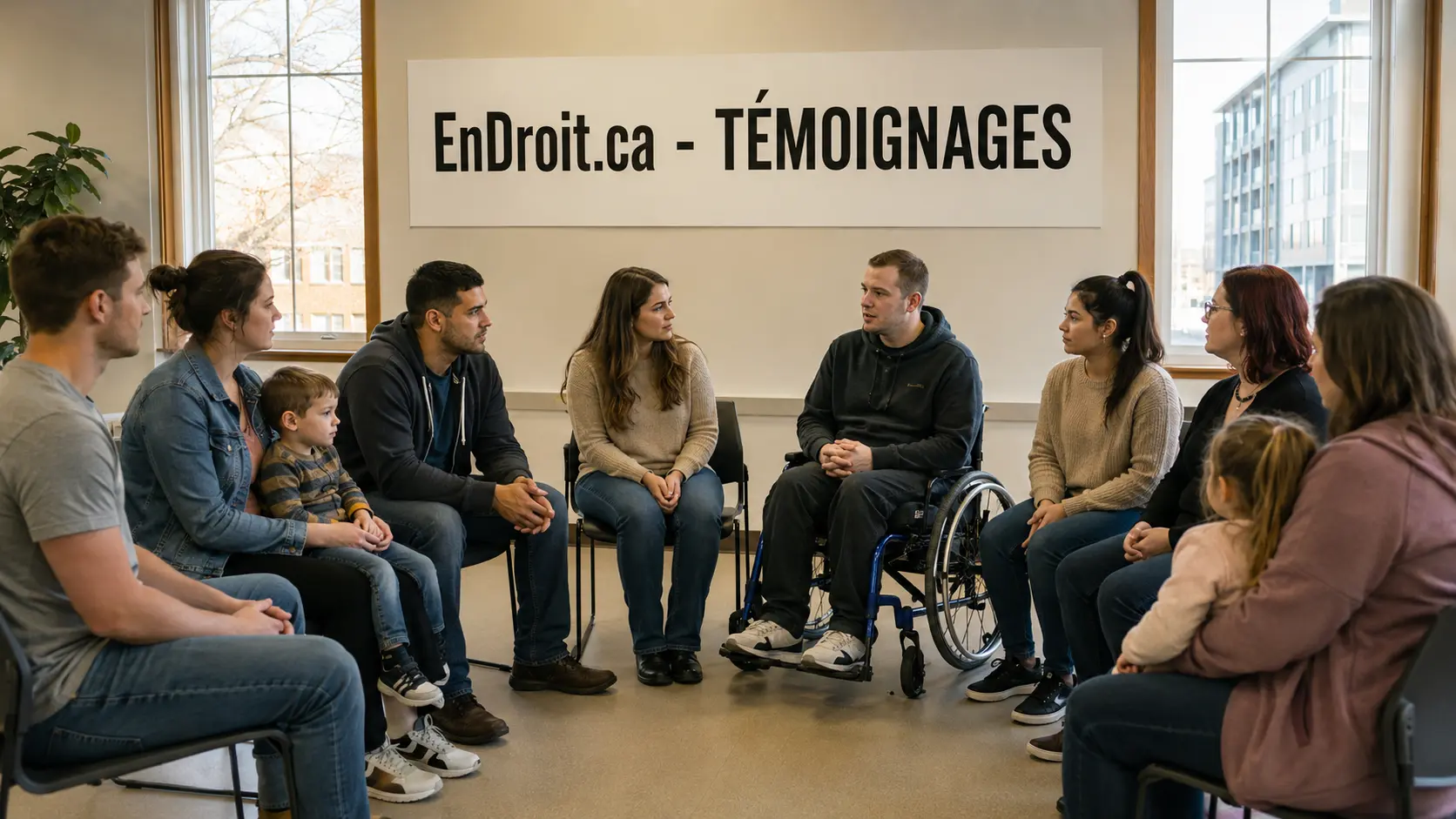
We could stop at theory. But there is something more conclusive than any argument: the testimonies. On our platform, dozens of people recount what the system put them through. And there is one sentence that no one, ever, has written. No one has said: “I was missing a citizens’ project to help me.” Not once.
What they all say is something else. I was wronged by the system. No one listened to me. My complaint wasn’t taken seriously. I wasn’t given a voice. I had no one to turn to. There is the real deficit. It isn’t quantitative — a shortage of programs to be filled with two million dollars. It is structural: a lack of independent recourse, of transparency, of an ear with no interest in the case. A citizens’ project that goes on ignoring precisely that is worth nothing, whatever its size.
That is why the comparison with election promises is more than a figure of speech. A call for projects that shifts the gaze toward “the access to justice of tomorrow,” at the very moment the present becomes uncomfortable, lowers the pressure without admitting anything. No one has to acknowledge a fault, reopen a file, or name a failing link in the chain. Third parties are funded to “serve better,” and the trust deficit becomes something to be filled with projects, rather than something the system produces. The cause stays off-camera. Carefully.
EnDroit.ca · The law, closer to citizens
Let the Bar, the Chambre and the Ministry fund front-line organizations — good, truly. Real people will draw real benefit from it. But let no one present this as an answer to the erosion of trust. Trust will not return because one more piece was added to a house from which citizens are shut out. It will return the day a citizen wronged by the system can knock on a door behind which stands someone with no stake at the table. On that day, there won’t even be any need for a poster.
Editorial note. This is a work of analysis and legal journalism, based on public sources and official data (government, Bar and Chambre des notaires news releases, Léger surveys, press coverage). The assessments it offers on the scope and limits of the Financial Assistance Program and the Summit on the Rule of Law are the editorial analysis of EnDroit.ca. EnDroit.ca is an independent legal-journalism platform. This article does not constitute legal advice. The author is not a lawyer.
Sources and references
The call for projects and the agreement. Gouvernement du Québec, “Appel de projets pour favoriser l’accès à la justice” (news release, June 29, 2026), quebec.ca · Droit-inc, “2 M$ pour soutenir l’accès à la justice” (June 2026) · Chambre des notaires du Québec, “Justice citoyens : programme d’aide financière” and “Entente historique : 80 millions de dollars pour favoriser l’accès à la justice” (April 2025), cnq.org · Barreau du Québec, “Aide financière pour favoriser l’accès à la justice” (February 10, 2026) and “80 millions de dollars pour favoriser l’accès à la justice,” barreau.qc.ca.
The Summit and the survey. Barreau du Québec / CNW, “Perte de confiance dans nos institutions : le Barreau lance un premier sommet pour protéger l’État de droit” (June 17, 2026) · Le Devoir, “Le Barreau tiendra un grand sommet sur l’État de droit durant la campagne électorale” (June 2026) · Radio-Canada, “Un sommet du Barreau sur la protection des institutions durant la campagne électorale” (June 2026) · La Presse, “Le Barreau tiendra un grand sommet durant la campagne électorale” (June 17, 2026). Figures drawn from three Léger surveys conducted for the Bar (May 2026).
Existing access-to-justice initiatives. Gouvernement du Québec / SOQUIJ, “Lancement de JuridiQC : le guichet unique d’information juridique” (October 13, 2020), a $17.2M investment under the 2018-2023 Plan to modernize the justice system · Centres Info Justice (formerly Centres de justice de proximité), justicedeproximite.qc.ca · Éducaloi, Réseau en éducation juridique, educaloi.qc.ca · Barreau du Québec, “Ressources utiles – Accès à la justice” (Fondation du Barreau, the “Seul devant la Cour” guide, Justice Pro Bono, Juripop, legal aid, university clinics), barreau.qc.ca · Ministry of Justice, Access to Justice Fund (more than $21M annually).
The rule-of-law campaign and counter-powers. Barreau du Québec, “Le Barreau du Québec craint une érosion de l’état de droit au Québec” (November 13, 2025) · Le Devoir, “Le Barreau lance une campagne sur l’importance de l’état de droit” (September 15, 2025) · La Presse, “Grande entrevue avec Me Marcel-Olivier Nadeau : des brèches dans notre état de droit” (November 21, 2025).
EnDroit.ca is an independent legal-journalism platform. This article does not constitute legal advice. The author is not a lawyer.
Auteur/autrice

En savoir plus sur EnDroit.ca
Subscribe to get the latest posts sent to your email.